Age of Failon – Birth of the Hero – Devlog #7
Devlog #7 – Rebuilding the Battle System
Over the last few devlogs, I have focused mainly on the world map, progression and the new objective system.
But eventually, every army has to fight.
And the Battle System has gone through a major transformation of its own.
The original battles already contained the foundations of the combat system, but their presentation no longer matched the direction Age of Failon was taking. As the world and interface evolved, combat needed to evolve with them.
The result is a redesigned battle experience with new environments, visuals, effects, sounds and improvements to the underlying combat systems.
A New Battlefield
One of the biggest visual changes is the battlefield itself.
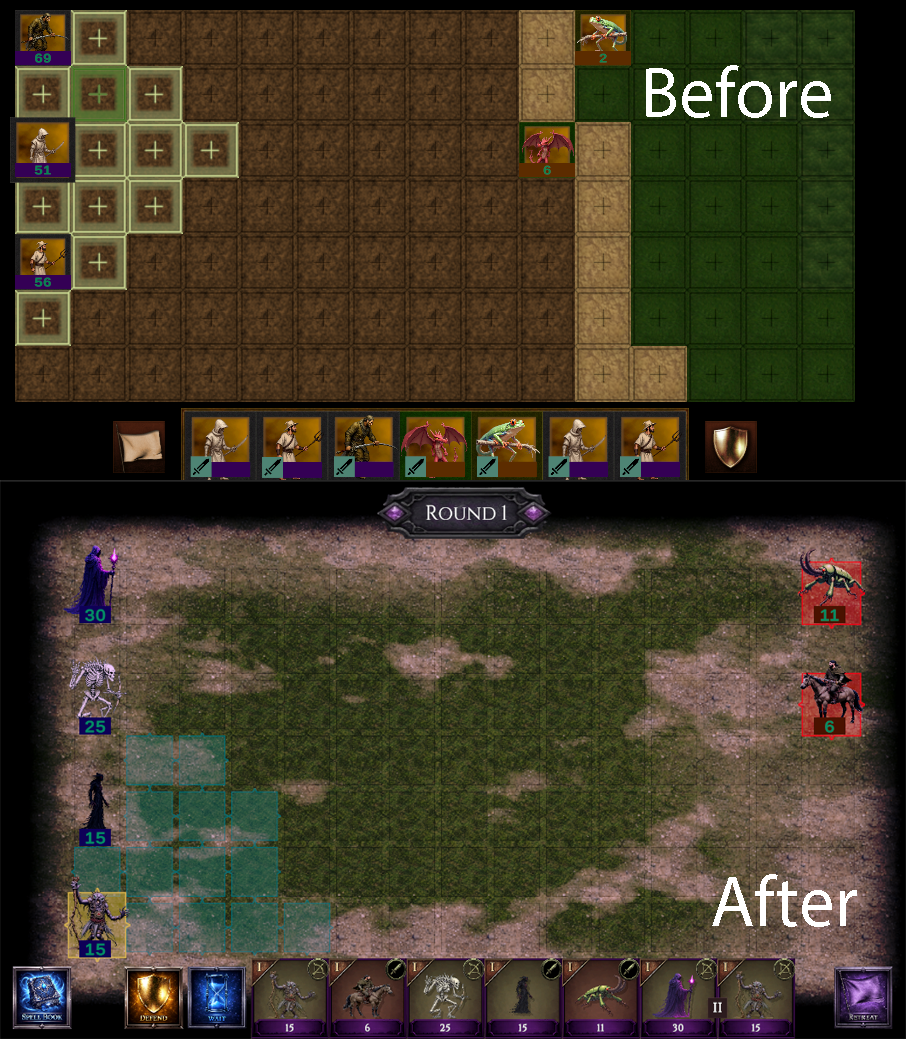
The original presentation was much flatter and more closely resembled a traditional grid-based board.
The new battlefield moves toward a 2.5D visual presentation while keeping the deterministic grid underneath the combat system.
Units still occupy defined positions and movement remains predictable, but the environment now provides much more depth.
Battlefields received new terrain, backgrounds, shaders and environmental elements designed to visually connect combat with the rest of Age of Failon.
The grid remains a gameplay system.
It no longer needs to define the entire visual identity of the battlefield.
Clear Tactical Information
Changing the presentation could not come at the cost of readability.
Age of Failon is still a turn-based strategy game, so the player needs to immediately understand where a unit can move, what it can attack and what action is currently being performed.
Movement ranges, paths, targets and unit information are therefore displayed directly over the battlefield when needed.
The interface was also redesigned alongside the rest of the game’s UI.
Unit information, turn order and combat actions now follow the same dark fantasy visual language introduced throughout Age of Failon.
The goal is to keep the battlefield visually richer without hiding the tactical information underneath it.
More Control During Combat
The combat flow itself has also received several improvements.
Units can perform the core actions expected from the battle system, including attacking, defending and waiting.
The Wait action required changes to the unit priority system so a unit can delay its action while remaining part of the current combat round.
Movement and targeting have also been improved to make common actions require less unnecessary input.
For example, attacking an adjacent enemy can now resolve movement and attack positioning more naturally instead of forcing the player through additional steps.
These may seem like small changes individually, but across hundreds of battles they have a significant impact on how combat feels.
Ranged Attacks and Magic
Ranged combat received a new visual effects system.
Different types of ranged units can now produce different impact effects, including arrows and several forms of magic.
Fire, dark, green, light, water and purple magical attacks can each have their own visual identity.
Spells have also moved away from simply displaying static images.
Many spell effects are now represented directly on the battlefield using particles and animated auras around affected units.
Offensive spells have received their own combat effects as well.
The goal is to make it immediately visible that something has happened without interrupting the flow of turn-based combat with unnecessarily long animations.
Battles Have Sound
Combat also received a new audio layer.
Units now have sounds for attacks and impacts, while movement and other actions can provide additional feedback during battle.
Different types of creatures and attacks can use different sounds rather than every combat interaction sharing the same generic effect.
Combined with the new visual effects, this makes attacks feel considerably more physical than in the earlier version of the battle system.
Heroes Matter in Battle
Armies on the world map are no longer just collections of units.
Enemy armies can now have their own generated characters behind them, allowing hero attributes and progression systems to participate in combat calculations.
The player’s hero develops throughout the campaign, and enemy commanders can be generated to provide appropriate opposition as progression continues.
This becomes particularly important when the objective system introduces a named or powerful enemy hero into a scenario.
The army you see on the battlefield is only one part of the encounter.
The character commanding it matters as well.
Hundreds of Maps Mean a Lot of Battles
Age of Failon contains a long persistent campaign, which means the Battle System needs to work across an enormous range of army strengths.
An encounter near the beginning of the game cannot be balanced in the same way as an encounter hundreds of maps later.
Hero attributes, skills, spells, unit strength and army composition all continue to grow.
Because of this, several combat calculations have also been redesigned, including unit power evaluation, hero power and the way some character bonuses scale.
The goal is to prevent progression from collapsing into simple linear stat inflation as the campaign becomes longer.
Quick Battle
Not every encounter needs to be played manually.
Age of Failon also includes Quick Battle for situations where the player wants to resolve combat without entering the full battlefield.
This is especially important in a campaign containing hundreds of maps.
Manual battles remain the core tactical experience, but once an encounter no longer represents an interesting tactical challenge, the game should not unnecessarily consume the player’s time.
Still Evolving
The Battle System is one of the largest systems in Age of Failon, and it will continue to evolve as development progresses.
But compared with the earlier version of the game, combat already looks and feels significantly different.
The battlefield has more depth.
Actions provide clearer visual and audio feedback.
Magic is represented directly in combat.
Enemy heroes participate in the underlying calculations.
And the system is being built with the enormous progression range of the full campaign in mind.
Next, we’ll return to another system that has changed just as dramatically:
the Castle, the Four Ages and the 456 units waiting across the full campaign.
Originally published on Product 4 You.